.png)


VERA LIFE PICKS
Glass & Stainless Steel Bakeware
No Coatings, No Compromises.
Some links are affiliate links, meaning I may earn a small commission if you purchase through them. I only recommend products that are low-toxin — free from unnecessary chemicals, pesticides, and seed oils — the same things I choose for my own home.
Muffin Pans
Choosing uncoated glass or stainless steel means fewer toxins because these materials are naturally non-reactive, free from coatings, and won’t leach chemicals. These long-lasting materials handle high temperatures without breaking down, protecting your food — and your family — over the long haul.

Baking Sheets & Cake Pans
Choosing uncoated glass or stainless steel means fewer toxins because these materials are naturally non-reactive, free from coatings, and won’t leach chemicals. These long-lasting materials handle high temperatures without breaking down, protecting your food — and your family — over the long haul.

Cooling Rack
Choosing uncoated glass or stainless steel means fewer toxins because these materials are naturally non-reactive, free from coatings, and won’t leach chemicals. These long-lasting materials handle high temperatures without breaking down, protecting your food — and your family — over the long haul.

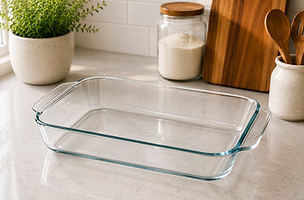
Casserole Dishes
Choosing uncoated glass or stainless steel means fewer toxins because these materials are naturally non-reactive, free from coatings, and won’t leach chemicals. These long-lasting materials handle high temperatures without breaking down, protecting your food — and your family — over the long haul.
Ramekins
Choosing uncoated glass or stainless steel means fewer toxins because these materials are naturally non-reactive, free from coatings, and won’t leach chemicals. These long-lasting materials handle high temperatures without breaking down, protecting your food — and your family — over the long haul.

Mixing Bowls

Oil Mister
The best way to add oil to your baking surface is with a refillable oil mister. A fine mist coats evenly without excess oil or aerosol propellants. Choose a glass bottle over plastic—glass won’t leach chemicals, holds up better over time, and is easier to clean for a truly non-toxic kitchen tool.

Less Scrubbing, Baking Soda to the Rescue
Parchment Paper
This website does not recommend using parchment paper. However, if you choose to use it, If You Care is the lower-toxic option compared to conventional brands, as it is Quilon-free and chlorine-free.

No-Go List for Baking
-
Silicone bakeware –While silicone is safe for low-heat uses like microwaving, boiling, and dishwasher cleaning, it is not ideal for high-heat baking. Repeated exposure to baking temperatures (typically 300–450°F) can cause lower-quality silicone and fillers to break down over time, releasing small amounts of chemicals into food. For this reason, silicone bakeware is not recommended for regular oven use.
-
Silicone baking mats – Same concern as silicone bakeware; coatings and fillers can break down at high temperatures over time.
-
Ceramic or stoneware of unknown quality – Glazes may contain lead or cadmium, especially in older or imported pieces. Even “food-safe” glazes can leach trace metals under high heat or acidic foods.
-
Non-stick coatings on sheet pans – PTFE or ceramic-based nonstick layers can degrade at baking temperatures, releasing fumes or micro-particles.
-
Decorative foil liners – Often dyed or printed with metallic or colored coatings; under high heat and moisture, these finishes can transfer chemicals or metals into food.
-
Aluminum foil – Bare aluminum can react with acidic or salty foods during baking, transferring aluminum into food; nonstick foil also carries a chemical coating.
-
Bare aluminum bakeware (muffin tins, sheet pans, cake pans) – Direct contact with batters or acidic ingredients can cause aluminum to leach; anodized aluminum is more stable but still not ideal at high heat or with acidic foods.
