.png)


The Emulsifier Problem: How Processed Food is Reshaping Your Microbiome
- Cathy Weaver
- Apr 25
- 8 min read

Updated: Jul 8

DEEPER DIVE
Oil and Water Don't Mix — And the Food Industry Spent Decades Fixing That. Here's What It Does to Your Gut.
If you've made it this far, you're probably the kind of person who wants to understand the 'why' behind the label — not just the list of what to avoid. This section gets into the actual science: what emulsifiers are, what the research found, and why it took this long for anyone to notice.
Emulsifiers are in almost every processed food on the shelf. To understand why that's a problem, I want to start with something that sounds completely boring: oil and water don't mix.
You already know this. You've seen a homemade vinaigrette separate in the fridge. You've watched natural peanut butter pool oil at the top. That's just chemistry doing what chemistry does. And for most of human history, we either shook things up before eating them or we didn't bother.
Then the food industry decided that separation was a problem worth solving — permanently, chemically, at scale. And that's where things get interesting.
What an Emulsifier Actually Does
An emulsifier is a molecule with a split personality. One end is attracted to water. The other end is attracted to fat. Drop it into a mixture of the two and it parks itself right at the boundary between them, coating the fat droplets and keeping them suspended in the water so they never settle out.
This is genuinely useful chemistry. Egg yolk has been doing this job in kitchens for centuries — it's why mayonnaise holds together and why hollandaise sauce doesn't break if you make it correctly. Lecithin, the compound in egg yolk responsible for this, is a naturally occurring phospholipid that the body knows exactly what to do with.
The emulsifiers in processed food are a different story.
Commercial food manufacturing scaled up dramatically through the mid-twentieth century, and with it came a very specific problem: how do you keep a product shelf-stable, consistently textured, and visually appealing for weeks or months after it's made?
Natural fats separate. Real dairy develops ice crystals. Bread goes stale. Salad dressings settle. None of that is acceptable when you're shipping products across the country.
So the food industry turned to synthetic emulsifiers — compounds engineered to be more stable, more consistent, and more effective than anything found in a kitchen. Polysorbate 80, carboxymethylcellulose, carrageenan, mono- and diglycerides — these became standard ingredients in everything from ice cream to bread to plant-based milks. They solved the manufacturing problem beautifully.
What nobody was particularly focused on at the time was what they'd do inside a human gut.
The Gut Lining: What's Actually at Stake
Before I get into the specific emulsifiers, it helps to understand what the research is actually concerned about — because this isn't about stomach upset or allergies. It's more fundamental than that.
The inside of your intestine is lined with a layer of mucus. One layer, produced by cells called goblet cells, that sits between the contents of your gut and the intestinal wall beneath it. This mucus layer does several things at once: it acts as a physical barrier, it houses most of your gut microbiome, and it helps regulate what gets absorbed into your bloodstream and what doesn't.
Below that mucus layer is a single layer of epithelial cells held together by what are called tight junctions. When tight junctions are working properly, they're selective — nutrients get through, bacteria and inflammatory compounds don't. When they're compromised, you get what's colloquially called leaky gut, and what researchers call increased intestinal permeability. That breakdown has been associated with chronic inflammation, metabolic disease, and autoimmune conditions.
The reason emulsifiers have attracted serious scientific attention is that specific ones appear to degrade this system — the mucus layer and the tight junctions — at amounts that people are already eating every day.
Polysorbate 80 and Carboxymethylcellulose: The Research That Changed Things
In 2015, researchers at Georgia State University published a study in Nature that stopped a lot of people in their tracks.
They exposed mice to low concentrations of two common emulsifiers — polysorbate 80 (P80) and carboxymethylcellulose (CMC, also labeled as cellulose gum on ingredient lists) — concentrations designed to approximate what a person eating a typical Western diet might consume. Then they watched what happened.
The gut microbiome shifted. Protective bacterial species declined. The mucus layer thinned. Bacteria moved closer to the intestinal wall than they should have been. Inflammatory markers went up. And the animals showed signs of early metabolic syndrome — weight gain, elevated blood glucose, insulin resistance.
Here's what made the findings especially significant: when they ran the same experiment on germ-free mice — animals with no gut microbiome at all — none of those effects appeared. The emulsifiers weren't directly damaging the intestinal tissue. They were acting on the bacteria, and the bacteria were doing the rest.
That's a problem for the way food additives are normally tested. Standard safety assessments look for direct tissue toxicity. This mechanism is indirect, mediated through the microbiome, and it wouldn't show up on a conventional safety test. Which means these additives could pass regulatory review while still producing meaningful biological harm — just not the kind anyone was looking for.
The Human Trial
Animal studies are a starting point, not a conclusion. Rodent microbiomes differ from human ones, and dosing is always an imperfect translation. For years, the emulsifier research was taken seriously in academic circles but couldn't be directly applied to dietary advice without human data.
That changed in 2022.
The FAIME study — a randomized, double-blind, placebo-controlled trial conducted in France — enrolled healthy adults and gave half of them CMC at dietary concentrations for twelve weeks. The other half ate an otherwise identical diet without it.
The CMC group showed measurable shifts in gut microbiome composition. Bacterial diversity decreased. Several species strongly associated with gut health — including Faecalibacterium prausnitzii and Akkermansia muciniphila, both of which you want plenty of — declined noticeably. A subset of participants developed signs of subclinical intestinal inflammation that weren't there at baseline.
These were healthy people. Eating one common food additive at amounts consistent with a normal diet. And something was measurably changing in their guts after twelve weeks.
That's the kind of evidence that's hard to explain away.
Carrageenan: Natural Doesn't Mean Safe
Carrageenan is extracted from red seaweed, which gives it a natural-origin story that has helped it land in a lot of organic and health-positioned products. Plant-based milks, organic dairy, deli meats, infant formula — it shows up across all of them.
Here's the thing about carrageenan that I find impossible to overlook: for decades, researchers have used it in laboratory settings specifically because it reliably induces intestinal inflammation in animal tissue. It became a standard research tool for that reason. The industry's response has always been that food-grade carrageenan is a different, higher-molecular-weight compound than the degraded form used in labs, and that the inflammation data doesn't apply.
The scientific community has not entirely agreed with that assessment.
Researcher Joanne Tobacman at the University of Illinois has spent years documenting concerns about carrageenan — arguing that under acidic digestive conditions, food-grade carrageenan degrades into lower-molecular-weight forms with inflammatory potential. Her work, along with independent research from other groups, has associated carrageenan with increased intestinal permeability and disrupted microbiome composition.
In 2016 the National Organic Standards Board — the body that decides what's allowed in certified organic products — voted to remove carrageenan from the approved list. The USDA overruled that recommendation. It stayed in.
The European Union took a different position and banned carrageenan from infant formula in 2018.
It remains fully approved in the United States. A growing number of brands have voluntarily removed it anyway, particularly from baby products. I'll let you draw your own conclusions about what that tells you.
Mono- and Diglycerides: The Trans Fat Loophole
This one requires a small detour into food labeling law, because there's a gap here that most people don't know exists.
In 2015, the FDA effectively banned industrially produced trans fats from the food supply based on decades of cardiovascular research. The rule applied to partially hydrogenated oils listed as ingredients. It did not apply to mono- and diglycerides, which are classified as additives rather than fats — even though they can be derived from the same partially hydrogenated oils and can contain trans fatty acids.
The result is that a product can carry a "0g trans fat" label while still containing trans fat content in the mono- and diglyceride fraction. A 2023 analysis found detectable trans fat in commercial bread products using mono- and diglycerides derived from partial hydrogenation. The amounts are typically small per serving. But the regulatory gap means there's no way to know the source of the mono- and diglycerides in a given product from reading the label.
Mono- and diglycerides are most common in commercial baked goods. They're one of the main reasons commercial sandwich bread stays soft for two weeks.
Lecithin: The One That's Fine
I want to be fair here, because not every emulsifier deserves the same level of concern.
Lecithin — from egg yolks, soybeans, or sunflower seeds — is a naturally occurring compound that has been used in cooking for centuries. It doesn't carry the gut-disruption signals that the research has identified for polysorbate 80, CMC, or carrageenan. The body knows what to do with it.
The main practical note: soy lecithin is the most common commercial form and is typically derived from genetically modified soybeans. Sunflower lecithin has become a widely available alternative for anyone who prefers to avoid soy or GMOs. Either way, when you see lecithin on a label, it's the least concerning thing on the list.
Knowing that distinction actually helps — it means when you're scanning an ingredient list, you can move past lecithin and focus your attention on the ones that matter.
Why They're Still Approved
The FDA operates on a GRAS system — Generally Recognized as Safe — where additives are evaluated at the time of approval and largely left alone unless new evidence triggers a reassessment. Most emulsifiers were approved decades before gut microbiome science existed as a field, before intestinal permeability was well understood, and before anyone was running controlled human dietary trials on individual food additives.
The 2022 FAIME study is exactly the kind of evidence the current system wasn't designed to generate or respond to automatically. The research exists. Regulatory action, when it comes, tends to lag by years or decades. That's not a conspiracy — it's just how the system is built. But it does mean that "FDA approved" and "well studied under current science" are not the same thing.
What to Actually Do
None of this requires a complete overhaul of how you eat. It requires paying attention to a specific category of ingredient in the products you use most often — especially the ones you eat every day.
The names to look for: polysorbate 80, carboxymethylcellulose, cellulose gum, carrageenan, and mono- and diglycerides. Those are the ones the research flags. Lecithin, in either soy or sunflower form, is generally not the concern.
Plant-based milks are worth checking carefully. Most oat, almond, and coconut milk products use carrageenan or CMC for texture. Cleaner versions exist — brands with short ingredient lists — and they're increasingly easy to find. Making your own takes about five minutes and contains nothing but the nut or grain and water.
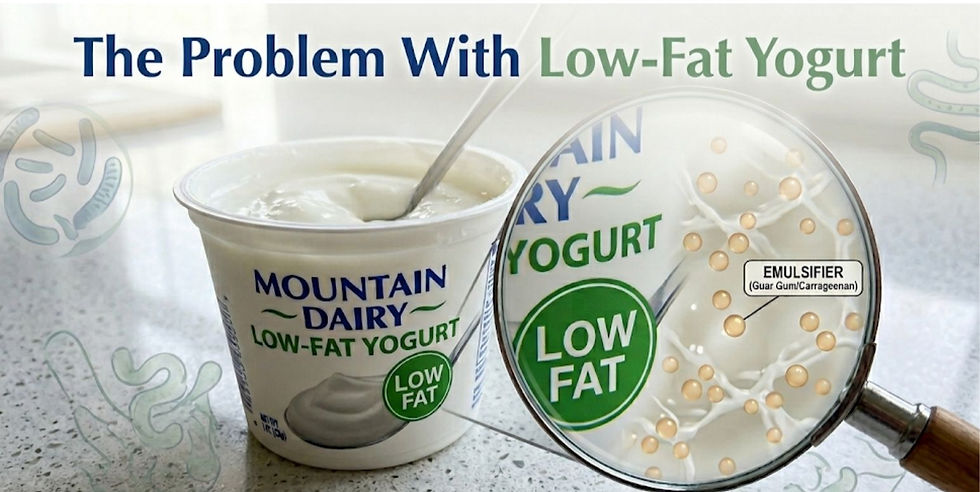
Yogurt is another daily staple where the difference between product types is significant. Plain whole-milk yogurt — nothing removed, nothing added — typically has two ingredients. Low-fat and flavored versions often have eight or ten, and several of those are usually emulsifiers or stabilizers.
Bread is where mono- and diglycerides are most concentrated. A sourdough made with flour, water, salt, and starter has none of them. Most commercial sandwich bread has several. The gap between those two products in ingredient list length is usually large, and it tells you something.
Organic labeling is not sufficient protection here. Carrageenan is still approved in organic products. The label tells you something meaningful about pesticides and farming practices. It doesn't tell you the product is emulsifier-free.
The gut lining is one cell thick. What touches it — consistently, daily, meal after meal — accumulates in ways that a single ingredient never would. The food industry added emulsifiers to solve a manufacturing problem. They work exactly as designed.
The question worth asking is whose problem they were actually solving.
For informational purposes only. Always consult a qualified healthcare provider regarding specific health concerns or before making changes to your diet based on individual health conditions.
This is just one piece of a much bigger puzzle. Head over to my food additives page to see how bleaching agents fit into the broader picture of what the food industry adds to our everyday staples."

Comments