.png)


How Blueberries Support Your Brain And Body
- Cathy Weaver
- Jul 7
- 4 min read

Updated: Jul 8

See the blueberry powder I recommend →
Affiliate link — I may earn a commission at no extra cost to you.

Small Berry, Big Impact
What Blueberries Actually Do, Backed by Research
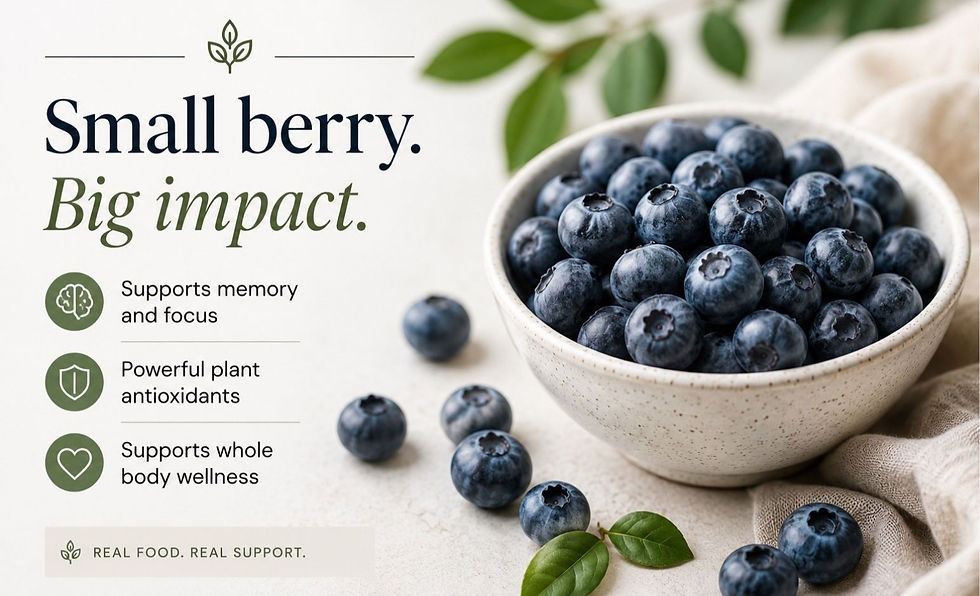
Blueberries have a way of getting filed under "healthy snack" without anyone quite knowing why. But dig into the research and a clear pattern shows up — the same handful of pigments responsible for that deep blue-purple color keep turning up across brain studies, circulation studies, and blood sugar trials. It's not one benefit riding on hype. It's one mechanism showing up in four different places in the body.
Sharper Memory, Quicker Thinking
The deep blue-purple color of a blueberry comes from a pigment called anthocyanin, and it's the reason researchers keep returning to this fruit in brain studies. In a King's College London trial, adults who consumed the equivalent of about 75 to 80 blueberries a day showed improved executive function, stronger short-term memory, and faster reaction times compared to a placebo group.
Older adults with early memory changes saw similar results after 12 weeks of daily wild blueberry juice — better word recall and better performance on learning tasks. Researchers believe the anthocyanins may improve blood flow to the brain and support the neuron signaling that memory depends on. It isn't a cure for anything. It's a small, daily nudge that compounds over time.
Warmer Hands, Lighter Legs
Cold hands and heavy, achy legs by the end of the day are often a circulation issue. Blood vessels need to widen and relax on cue — a process called flow-mediated dilation — and that's exactly what blueberry anthocyanins have been shown to support in clinical research.
In one trial, daily blueberry consumption for a month measurably improved blood vessel function and lowered 24-hour systolic blood pressure, a reduction researchers compared to what some blood pressure medications achieve. The proposed mechanism: anthocyanin metabolites help trigger nitric oxide production, which relaxes and widens blood vessels, allowing blood to move more freely to the extremities. The effect has been shown to appear within about two hours of eating blueberries, and to build further with sustained daily intake.
Steadier Blood Sugar
Fruit and blood sugar don't always get along on paper, but blueberries are a notable exception. A cup has a glycemic load under 10, roughly half that of a single potato. Beyond that low starting point, research suggests they may actively help regulate blood sugar response.
In a Pennington Biomedical Research Center trial, adults with insulin resistance who drank blueberry smoothies twice daily for six weeks showed meaningfully improved insulin sensitivity compared to a placebo group. It's worth noting that a later, larger Pennington trial in adults with metabolic syndrome did not replicate this effect on insulin sensitivity or blood pressure — a reminder that this research is promising but not yet unanimous. Other research has found that eating blueberries alongside a carbohydrate-heavy meal blunted the post-meal blood sugar spike that would otherwise follow. Not every study agrees — a few found no measurable change — but the pattern across trials leans consistently positive, and the studies showing the strongest effect used whole, fresh or frozen blueberries rather than juice or extract supplements.
A Quiet Ally for Skin
Skin ages from the inside out just as much as from sun exposure. Oxidative stress breaks down collagen over time, which is what leads to the fine lines and sagging most people associate with getting older. Blueberries are one of the most concentrated fruit sources of antioxidants available, and the same anthocyanins that support the brain and blood vessels also help neutralize the free radicals responsible for that breakdown.
This won't replace a skincare routine. But it's one more way of protecting the same collagen a serum is working to preserve — from a direction skincare alone can't reach.
How to Actually Get the Benefit
Frozen works just as well as fresh
Most of the clinical trials used freeze-dried or frozen berries, since flash-freezing locks in the anthocyanins.
Consistency over quantity
A small daily handful, about three-quarters to one cup, beats an occasional large serving — the benefits shown in research built up over weeks of regular intake.
Skip the juice
Juicing strips the fiber and dilutes the anthocyanin concentration per serving. Whole berries, blended into a smoothie if you like, are where the research points.
Pair them with a meal
The blood sugar research specifically looked at blueberries eaten alongside carbohydrates, not on their own.
The Bottom Line
Most foods that get called "superfoods" are riding on a single study or a marketing campaign. Blueberries have a stack of independent, peer-reviewed trials behind them — on the brain, the blood vessels, blood sugar, and beyond. That doesn't make them a cure for anything. But it does make them one of the rare foods where the evidence and the hype are actually pointing in the same direction.
This is for informational purposes only. Always check with your healthcare provider if you have specific health concerns.
Sources
Rodriguez-Mateos A, et al. The "BluFlow" study, King's College London and University of Reading. American Journal of Clinical Nutrition, 2023. kcl.ac.uk
Stull AJ, et al. Bioactives in Blueberries Improve Insulin Sensitivity in Obese, Insulin-Resistant Men and Women. The Journal of Nutrition, Pennington Biomedical Research Center. pmc.ncbi.nlm.nih.gov
Stull AJ, et al. Blueberries Improve Endothelial Function, but Not Blood Pressure, in Adults with Metabolic Syndrome: A Randomized, Double-Blind, Placebo-Controlled Clinical Trial. Nutrients, 2015, Pennington Biomedical Research Center. mdpi.com


Comments