.png)


The Health Benefits of Pomegranate: What the Research Actually Shows
- Cathy Weaver
- Jul 15
- 5 min read

Updated: 4 days ago

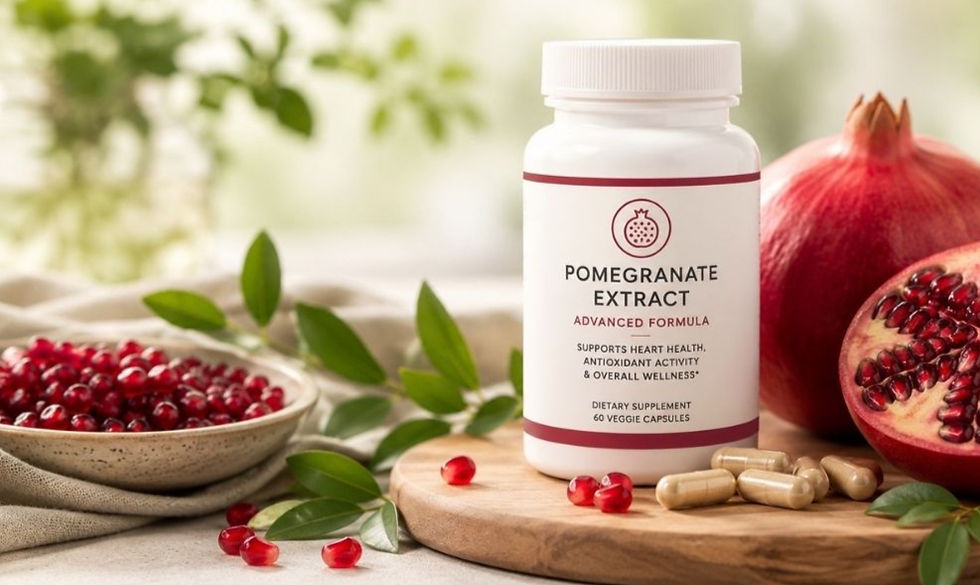
Affiliate link — I may earn a commission at no extra cost to you.


One ruby-red fruit, four systems worth tracking — and a surprisingly deep body of clinical evidence behind it
Pomegranates have carried a health halo for thousands of years, but the interesting part is more recent: this is one of the more heavily studied fruits in modern nutrition research, with dozens of randomized, placebo-controlled human trials behind it. Not all of them agree. Some effects show up reliably. Others are promising but still thin. That mix — instead of a blanket "superfood" claim — is actually the most honest way to talk about what this fruit does.
Most foods ask you to take their benefits on faith. Pomegranates keep showing up in blood pressure readings, inflammatory panels, and gut microbiome analyses instead.
Blood Pressure and Heart Health
The effect with the deepest research backing
Of all the claims made about pomegranate, its blood-pressure-lowering effect is the one with the most consistent evidence behind it. This isn't a single promising study — it's a pattern that has held up across numerous randomized controlled trials. A meta-analysis pooling 16 separate clinical trials confirmed a measurable reduction in inflammatory markers tied to cardiovascular risk.
Notably, that same body of research found the benefit was more pronounced in people who were overweight or obese, likely because they start with more elevated inflammation and blood pressure to begin with. If your numbers are already in a healthy range, the effect may be more modest — but for people with room to improve, the pattern across studies is consistently positive.
Metabolic Markers: Weight, Cholesterol, and Blood Sugar
What a 20-study systematic review found
One rigorous systematic review screened over 5,600 studies down to the 20 that met strict clinical trial standards, then evaluated pomegranate's effect on metabolic syndrome — the cluster of issues including excess weight, high blood pressure, and unhealthy cholesterol levels that raises the risk of heart disease and diabetes.
The pooled evidence pointed toward real benefit across multiple markers: reduced body weight, lower blood pressure, improved blood sugar, lower triglycerides and LDL cholesterol, higher HDL cholesterol, and improved insulin resistance. The researchers were clear, though, that the field still needs better-designed trials to pin down the ideal dose and format. This is one of the broadest, most consistent bodies of evidence for any single fruit — but "promising" and "proven" aren't the same thing, and the researchers say so themselves.
Sharper Thinking, Calmer Inflammation
The polyphenol effect on the aging brain
Pomegranates are unusually concentrated in punicalagins, a class of polyphenols that give the fruit its deep color and much of its research interest. In a 2025 randomized, double-blind trial out of Manchester Metropolitan University, adults aged 55–70 took a 740 mg pomegranate extract daily for 12 weeks and showed measurable improvements in cognitive and physical function compared to a placebo group.
A companion trial from the same research team found reductions in inflammatory markers over the same 12-week period — relevant because chronic, low-grade inflammation is thought to play a role in both cognitive decline and age-related disease. The proposed mechanism is that punicalagins and their metabolites help tamp down oxidative stress at the cellular level.
This is a genuinely exciting research area, but it's still early — the trials are small (fewer than 100 participants) and focused on concentrated extract, not a fixed serving of whole fruit.
Your Gut Bacteria Have a Favorite Fruit
Why pomegranate needs your microbiome to work
Here's the twist that makes pomegranate different from most other polyphenol-rich fruits: its signature compounds, called ellagitannins, are barely absorbed by the body on their own. They have to pass through the gut first, where certain bacteria convert them into a new class of compounds called urolithins — and it's the urolithins, not the original polyphenols, that actually get absorbed and appear to do the work.
A 2024 randomized, placebo-controlled trial found that four weeks of a concentrated pomegranate extract shifted the gut microbiome — increasing several beneficial bacterial species — while significantly raising circulating short-chain fatty acids, including a 162% rise in propionate, a compound tied to gut and metabolic health. Earlier small studies found similar increases in beneficial genera like Bifidobacterium in most subjects who took it.
Not everyone's gut bacteria convert ellagitannins into urolithins equally well, which may be part of why pomegranate seems to help some people more than others.
How to Actually Get the Benefit
100% juice is fine here
Unlike some fruits, most of the human trials behind these findings used pomegranate juice or concentrated extract — not just whole arils — so juice isn't a downgrade for this one.
Give it weeks, not days
The strongest results — on inflammation, cognition, and blood pressure — came from daily intake sustained for 12 weeks, not a single serving.
Check the label
Look for 100% pomegranate juice with no added sugar. Many "pomegranate blend" juices are mostly apple or grape juice with a small amount of actual pomegranate.
Your gut needs time to adapt
The gut microbiome shifts seen in research took several weeks to show up — this isn't a same-day effect, so give it a few weeks before deciding whether it's doing anything for you.
An Ancient Fruit With a Surprisingly Modern Research Trail
Pomegranate is one of the more thoroughly tested fruits in nutrition science, and the picture that emerges isn't "miracle cure" or "marketing myth" — it's somewhere more useful in between. Blood pressure and broader metabolic markers have the strongest backing. Brain health and gut microbiome research are newer, but they're some of the most active — and genuinely interesting — corners of the field right now. That's not a knock against the fruit — it's what real science looks like when you let all the evidence speak.
For informational purposes only. Always check with your healthcare provider if you have specific health concerns.
Sources
Farhat, G., Malla, J., Vadher, J., & Al-Dujaili, E.A. (2025). Effects of pomegranate extract on inflammatory markers and cardiometabolic risk factors in adults aged 55–70, Nutrients, 17(7), 1235. mdpi.com
Farhat, G., Malla, J., Al-Dujaili, E.A., Vadher, J., Nayak, P., & Drinkwater, K. (2025). Impact of pomegranate extract supplementation on physical and cognitive function in community-dwelling older adults aged 55–70, Geriatrics, 10(1), 29. mdpi.com
Sivamani, R.K., Chakkalakal, M., Pan, A., Nadora, D., Min, M., Dumont, A., Burney, W.A., & Chambers, C.J. (2024). Prospective randomized, double-blind, placebo-controlled study of a standardized oral pomegranate extract on the gut microbiome and short-chain fatty acids, Foods, 13(1), 15. mdpi.com
Tabeshpour, J., Razavi, B.M., & Hosseinzadeh, H. (2022). Pomegranate and metabolic syndrome risk factors and outcomes: a systematic review of clinical studies, Nutrients, 14(8), 1664. mdpi.com
García-Villalba, R., Giménez-Bastida, J.A., Cortés-Martín, A., Ávila-Gálvez, M.A., Tomás-Barberán, F.A., Selma, M.V., Espín, J.C., & González-Sarrías, A. (2022). Urolithins: a comprehensive update on their metabolism, bioactivity, and associated gut microbiota, Molecular Nutrition & Food Research, 66(7), 2101019. onlinelibrary.wiley.com


Comments