.png)


The Complete Guide to Real Whole Food: What It Does in Your Body and Why It Works
- Cathy Weaver
- Apr 18
- 9 min read

Updated: May 9


DEEPER DIVE
Real Whole Food: What It Actually Does in Your Body and Why It Works
If you've made it past the widget, you're probably already thinking about food differently than most people around you. This section gets into the actual science — what real whole food is doing at a cellular level, why the research on it is so consistent, and how we ended up in a food system where the basics needed explaining in the first place.
Spoiler: it didn't happen by accident.
We Used to Just Call It Food
For most of human history, nobody needed a definition of "real food." You grew it, raised it, caught it, or bought it from someone who did. It had one ingredient. It spoiled. You cooked it and ate it. That was the whole system.
Then the twentieth century happened.
Industrialization changed food production the same way it changed everything else — it made things faster, cheaper, and shelf-stable. Canning, refrigeration, and eventually chemical preservation meant food could travel farther and last longer. That was genuinely useful for a while. The problem came when the industry didn't stop there.
By the time we hit the 1950s and 60s, food manufacturers had figured out that you could take cheap raw ingredients, strip them down, recombine them with additives, and sell the result for more than the sum of its parts. Flour got bleached and enriched. Fats got hydrogenated. Shelf life got extended with synthetic preservatives. Flavor got added back in with compounds engineered in laboratories.
The food looked the same. The label said similar things. But something had been lost in the translation — and for a few decades, nobody had the tools to measure exactly what.
We do now.
What the Research Is Actually Measuring
The field that changed everything was gut microbiome research. Starting in the early 2000s and accelerating through the 2010s, researchers began mapping the trillions of microorganisms that live in the human gut — and discovering that they were doing far more than anyone had suspected.
Your gut microbiome isn't just involved in digestion. It regulates immune function. It produces neurotransmitters — including a significant portion of your body's serotonin. It communicates directly with your brain through the vagus nerve. It influences how your body responds to insulin. It affects inflammation levels throughout the entire body, not just in the gut.
And it is exquisitely sensitive to what you feed it.
A diverse microbiome — one with many different species, each doing different jobs — is one of the most consistent predictors of good health outcomes across the research. A depleted one, with low diversity and an overgrowth of certain species at the expense of others, shows up repeatedly in the background of chronic disease: obesity, type 2 diabetes, cardiovascular disease, autoimmune conditions, depression, Alzheimer's.
Real whole food feeds a diverse microbiome. Ultra-processed food, over time, depletes it.
That's not a simplification. That's genuinely what the research shows.
The Fiber Problem Nobody Talks About Enough
The average American eats about 15 grams of fiber per day. The recommended amount is 25 to 38 grams. That gap — roughly half the minimum — is not because people aren't trying. It's because ultra-processed food has displaced the whole food that carries fiber, and most people don't realize how much ground they've lost.
Fiber does several things that nothing else does quite as well.
It slows the absorption of glucose from a meal. This is why eating a whole apple produces a very different blood sugar response than drinking apple juice, even though the sugar content is similar. The fiber is the difference. Remove it — as food processing routinely does — and you get a spike where you would have had a curve.
Prebiotic fiber is the primary food source for the beneficial bacteria in your gut. Without enough of it, those populations shrink. The species that thrive on fiber — Faecalibacterium prausnitzii, Akkermansia muciniphila, Bifidobacterium — are among the ones most consistently associated with good health outcomes. They need to eat, and what they eat is the fiber in real food.
When gut bacteria ferment fiber, they produce short-chain fatty acids — butyrate in particular. Butyrate is the primary fuel for the cells that line your colon. It reduces intestinal inflammation. It strengthens the gut barrier. It has systemic anti-inflammatory effects that extend well beyond the gut. You cannot get butyrate from a supplement the way your colon gets it from fermentation. The process is the point.
Soluble fiber also binds to bile acids — compounds made partly from cholesterol — and carries them out of the body. This is one of the most consistent mechanisms in cardiovascular research. It's how oats lower LDL cholesterol. It's why the evidence there is so strong. The fiber is doing chemistry that no drug has fully replicated.
Protein: The Macronutrient the Low-Fat Era Quietly Neglected
When the low-fat guidelines took over in the 1980s, fat became the villain. Carbohydrates got elevated as the replacement. Protein mostly got ignored — treated as something you needed enough of, but not something worth optimizing.
That turned out to be a mistake.
Protein isn't just structural — though it is that too, in a fundamental way. Every enzyme in your body is a protein. Every antibody your immune system makes is a protein. The neurotransmitters that regulate your mood, focus, and sleep — dopamine, serotonin, GABA — are synthesized from amino acids that come from the protein you eat. Your body cannot store excess amino acids the way it stores fat or glycogen. It needs a regular supply.
What the research has clarified over the last two decades is how central protein is to satiety — the feeling of genuine fullness that lasts. When protein is present at a meal, it triggers the release of satiety hormones: PYY and GLP-1 signal to the brain that you've eaten. Hunger stays quiet longer. Blood sugar stabilizes. The cycle of craving that drives overeating — the one that processed carbohydrates tend to amplify — is significantly blunted.
This is why what you eat for breakfast shapes the entire arc of your day in ways the other meals don't. The hormonal environment you set in the first hour carries forward. A high-protein breakfast produces a measurably different appetite pattern than a high-carbohydrate one. The research on this is consistent enough that it's no longer particularly controversial.
Higher protein intake is also one of the most reliable interventions for preserving muscle mass as we age — which matters more than most people realize. Muscle is metabolically active tissue. It burns more calories at rest than fat. It improves insulin sensitivity. It protects against falls and functional decline. Losing it quietly through a low-protein diet in middle age creates problems that compound over time.
Fat: What the Science Actually Said
The hypothesis that dietary fat causes heart disease was popularized in the 1960s largely through the work of Ancel Keys, a physiologist who studied the relationship between fat intake and cardiovascular disease across countries. The data he published was influential. It was also, as later researchers established, selectively presented — countries that didn't fit the pattern were excluded from the analysis.
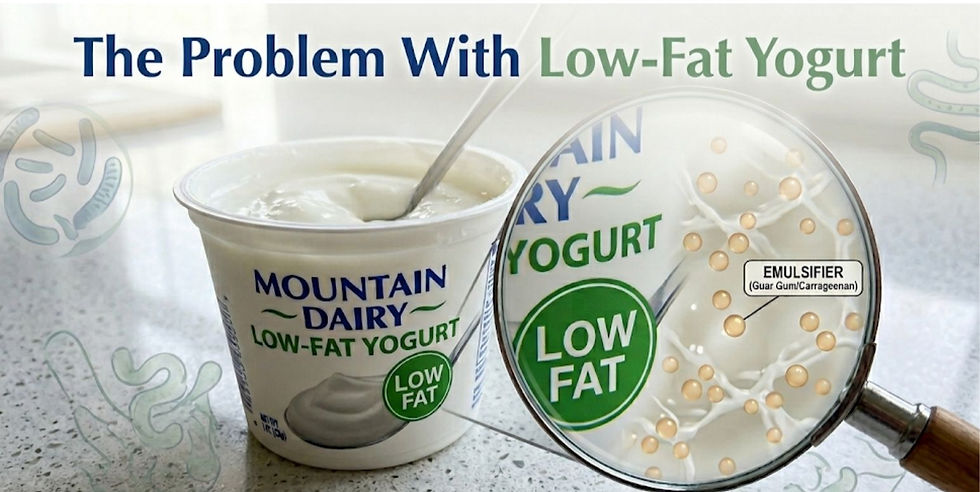
The low-fat guidelines that followed were built on a foundation that was shakier than the public was told. And by the time the contradictory evidence accumulated enough to shift the consensus — roughly the early 2000s — the food industry had already spent three decades reformulating products around the original hypothesis. Low-fat versions of everything. Fat replaced with sugar and refined carbohydrates. Hydrogenated vegetable oils in place of natural fats.
What the research actually shows is that fat is not the enemy. The type of fat is what matters.
Natural fats from whole food sources — olive oil, avocados, nuts, seeds, fatty fish, quality animal fats — are not just safe. They're essential. The body uses them to build every cell membrane. The brain is nearly 60 percent fat by dry weight, primarily DHA, an omega-3 fatty acid found in fatty fish. Low DHA levels are associated with depression, cognitive decline, and increased Alzheimer's risk. Fat-soluble vitamins — A, D, E, and K — cannot be absorbed without dietary fat present. A fat-free diet is not a healthy diet. It's a nutrient-deficient one.
The fats that deserve concern are the industrial ones: partially hydrogenated vegetable oils (trans fats), and the highly refined seed oils that dominate the modern food supply and shift the omega-6 to omega-3 ratio in ways the human body was never designed to handle. Those are the fats the research flags. Not the olive oil. Not the egg yolk.
Why Whole Food Works Better Than the Sum of Its Parts
One of the more interesting findings in nutritional science over the last twenty years is how consistently isolated nutrients fail to replicate the effects of the whole foods they come from.
Antioxidant supplements — beta-carotene, vitamin E, vitamin C — have repeatedly underperformed in large clinical trials compared to diets rich in antioxidant-containing foods. In some cases, high-dose supplementation has shown harm where food intake showed benefit.
The beta-carotene trials in smokers are the most cited example: supplementation increased lung cancer risk in a population where dietary beta-carotene was protective.
Researchers now describe this under the concept of food synergy — the idea that the components of whole food work together in biological contexts that isolated supplements can't replicate. Lycopene from tomatoes is more bioavailable when the tomatoes are cooked in olive oil. Vitamin C from food dramatically increases iron absorption from plant sources in ways that ascorbic acid supplements do not consistently reproduce. Curcumin in turmeric becomes highly bioavailable in the presence of piperine from black pepper — a pairing that shows up independently in traditional cuisines on opposite sides of the world.
These aren't coincidences. They're the result of millions of years of co-evolution between human biology and the foods that sustained it. Your digestive system, your microbiome, your liver — all of them developed alongside these foods. They know what to do with them in a way they simply don't with a capsule.
The unit of nutrition isn't the nutrient. It's the food.
What "Processed" Actually Means — and Why Degree Matters
Not all processing is the same, and it's worth being precise about this because the word gets used too loosely.
Fermentation is processing. So is cooking. So is cutting, freezing, and canning. These forms of processing are ancient, they're compatible with whole food, and several of them — fermentation especially — actually increase the nutritional value of food by making nutrients more bioavailable and introducing beneficial bacteria.
What researchers mean when they flag "ultra-processed food" — the NOVA classification system is the most widely used framework — is something specific: industrial formulations made mostly from substances extracted from food rather than whole food itself. Refined starches. Hydrogenated fats. Isolated proteins. Added sugar in multiple forms. Synthetic flavors, colors, emulsifiers, thickeners, and preservatives to make the result taste, look, and feel like something it isn't.
The research on ultra-processed food consumption is striking in its consistency. A 2019 study in the British Medical Journal following over 100,000 French adults found that a 10 percent increase in ultra-processed food consumption was associated with significantly higher rates of cardiovascular disease, coronary heart disease, and cerebrovascular disease. A 2022 analysis of over 200,000 participants across three large US cohorts found associations between ultra-processed food intake and increased risk of early death. These aren't small studies. They're not outliers.
The mechanism isn't fully established — it's probably multiple overlapping ones, including the displacement of fiber, the gut microbiome disruption from emulsifiers and other additives, the blood sugar effects of refined carbohydrates, and the overconsumption driven by hyperpalatable engineering. But the direction of the evidence is not ambiguous.
The Practical Version of All of This
I want to end with something honest: you don't have to eat perfectly to eat significantly better.
The research on whole food doesn't require a complete overhaul of your kitchen or a commitment to eating foods you don't enjoy. It requires shifting the balance. More meals built around real ingredients. Fewer products built around industrial substitutes. A grocery cart where most things spoil eventually.
Protein at every meal. Fat from real sources. Fiber from vegetables, legumes, and whole grains. Variety across the color spectrum. A small amount of fermented food regularly. An ingredient list you can read.
That's the whole framework. It's not complicated. It's just different from what the modern food supply defaults to — which is why it takes some intention.
The food industry spent decades making processed food more convenient, more palatable, and more available than real food. They did an excellent job. The result is that eating well now requires a little more effort than it used to. But the biology hasn't changed. Your body still knows exactly what to do with real food.
It always did. We just got talked out of feeding it that way.
For informational purposes only. Always check with your healthcare provider if you have specific health concerns related to diet and nutrition.
Head over to my food additives page to see how the ingredients in processed food fit into the broader picture of what we're actually eating.


Comments